Tuesday, July 1, 2014

Empress Dowager Cixi


Empress Dowager Cixi
Jung Chang
Great Britain, Jonathan Cape, Random House.
2013 436 pp RRP $40
ISBN 9780224087445 (trade paperback edition)

As number six Concubine of Emperor Xianfeng of China, Cixi should have had no influence in the court. However, the first concubine, Empress Zhen, had no children. When Cixi (Si-Shee) gave birth to the Emperor’s son, her status was elevated to mother of the future Emperor. Throughout the following decades, she became a woman of enormous influence and has been credited with bringing China into the modern world.
The author, Jung Chang, is well known for her popular first book, Wild Swans, (1991), a sweeping tale of three generations of Chinese women, and her second book, Mao the Unknown Story, (2005).
Jung Chang knows the intrigues of the country of her birth. For Empress Dowager Cixi she was able to access ‘newly available, mostly Chinese, historical documents such as court records, official and private correspondence, diaries and eye-witness accounts’ of the events recorded. From these she was able to construct a fast-paced and gripping drama and an intimate portrait of an extraordinary woman.
Empress Dowager Cixi managed to overcome her powerlessness as a woman by knowing how to manipulate the men and systems around her. At the time of Cixi’s story, 1835 to 1908, the throne was firmly in the grasp of the Manchu minority, known as the Qing dynasty. In 1852, the sixteen-year-old girl from a prominent family was among several chosen as concubines for Emperor Xianfeng and was brought into the court.
Her husband was about 30 when he died in 1861 while in exile from Beijing. His five-year-old son by Cixi was now named the new Emperor Tongzhi, with power in the hands of a Board of Regents. Cixi and the Empress staged a coup and seized the title from the Regents. Thus began Cixi’s long hold on power, conducted from behind her silk screen. Out of the forty-seven years of her Regency, from 1861 until her death in 1908, she effectively ruled for thirty-six years (her son for two and her adopted son for nine).
 When he reached the marriageable age of seventeen, Tongzhi became Emperor and Cixi had to retreat to the harem and keep out of politics.
He died two years later. Cixi quickly adopted her sister’s three-year-old son and named him the new Emperor, Guangxu, with his father, Prince Chun, (her brother-in-law) as guardian. Cixi regained control.
When the new Emperor reached late teens he married and took power, relegating Cixi once again to the harem.
The new Emperor allowed many of Cixi’s reforms to lapse.  He hated Westerners and would have nothing to do with them. He let the navy and army shrink so much that when Japan attacked they got an easy victory. After seeing his country almost overrun by foreign powers he reluctantly let Cixi share power and for many years they ruled together.
The court had to flee Beijing when it was besieged by the Japanese in 1898. She made disastrous decisions about the Boxers who brought incredible destruction on the population and countryside. Later, Cixi apologised profusely and brought in several measures in an effort to make amends.
Before her death great changes were coming over China and the Han Chinese were agitating to wrest control from the thousand-year-old Manchu dynasty. The weak Emperor was ready to hand the country over to the Japanese who were waiting to pounce. Forward-looking as always, Cixi put in place measures to ensure the survival of China as an independent country, and the survival of her Manchu people.
The Emperor died on 14 November 1908 and Cixi died the following day.
Cixi had been working towards changing the governance of China into a Constitutional Monarchy. On her death-bed she appointed her two-year-old great-nephew, Puyi, as the next Emperor. When Emperor Puyi was five years old, the people staged a coup and the country became a Republic. That story is told in the movie The Last Emperor.
Jung Chang’s lively writing gives extraordinary insight into this fascinating era. For those with an interest in China, or those wanting an exciting tale of a strong and remarkable woman who was ahead of her time, this book is highly recommended.


A Blonde in the Bazaar


A Blonde in the Bazaar
Jill Worrall
New Holland Publishers (NZ) Ltd. 2003


Jill Worrall loves Pakistan. In her four visits over the years as a travel writer and tour guide she has got to know the local people and landscape. Her enthusiasm shows as she shares the country with us.
Our perceptions of Pakistan are coloured by the way the country is portrayed in the media for all the wrong reasons. In this book we get a different view as we are introduced to the local people, fragrant bazaars, soaring mountain ranges and dangerous roads. We go with Jill on a camel ride through the dusty desert, a boat trip down the Indus River, and we visit temples and mosques, local homes, and ancient hotels.
Worrall is an accomplished writer who takes us confidently along on her travels. From her home in Timaru, New Zealand to the exotic vastness of Pakistan, and with years of travel writing behind her, Worrall makes the country come alive as if we are there with her.
I loved her recent book about Iran, Two Wings of a Nightingale, and this earlier book about Pakistan doesn’t disappoint.

Sunday, June 22, 2014

The Girl Who Saved the King of Sweden


This is another wide-ranging, improbable tale from Jonas Jonasson, author of The 100-year-old Man Who climbed out of The Window and Disappeared.
From desperate conditions in Soweto, South Africa, to being imprisoned in a nuclear facility, and eventually to Sweden, the story follows the unlikely fortunes and misfortunes of heroine, Nombeko, and the people she meets along the way.
In true Jonasson tradition historical facts are mixed with fantasy in such a way that you are reaching for the history books to check out the true story.
Monarchies and Republics, atomic bombs and spies, the young, old and eccentric come together in a delightful mix that has you laughing out loud.
Jonasson brings the story alive with fun characters, fast-paced narrative, real historical leaders, and realistic descriptions of real and imaginary places.
I thought the 100-year-old man was more believable, but this is still a great yarn and I thoroughly enjoyed it.
Highly recommended.

Wednesday, May 21, 2014

The Secret Life of Kim Dotcom


The Secret Life of Kim Dotcom
David Fisher
Paul Little Books Auckland, 2013
ISBN 9780-473-259-433
224 pp RRP $30

With the subtitle Spies, Lies and the War for the Internet you would expect intriguing revelations and David Fisher doesn’t disappoint. We are all mixed-up human beings, but none more so than Kim Dotcom. Here the many sides of this complex character are presented, with fascinating details of his fortunes and misfortunes.

Fisher is a senior reporter for the Auckland Herald, New Zealand, and he makes it clear that this is not an authorised biography. It is, however, based on many personal interviews with the subject, as well as extensive research.

The saga uncovers Kim’s early life (born Kim Schmitz) as a lonely child in Germany, his early forays into the internet, his extraordinary knowledge, his close friends and associates – all brilliant computer whizzes – the story of why he came to New Zealand and the police raids on his home on January 20 2012. It follows the subsequent court cases and fall out with politicians and people in high places.

Fisher has been accused of giving undue reverence to a criminal. Dotcom is a flawed character and he is shown here in many guises, both good and bad. I think Fisher has done a great job of trying to present the story as he sees it, and he has tried to depict all sides of the story.

It is a tale of much more than the life of one man. We have politicians, the New Zealand Government, the American FBI and more. It shows cracks in the systems, why the FBI were involved in the raids, and much, much more.

Our opinions are often shaped by the media and the outcome is a very shallow view of events. This book is trying to give a rounded story to fill in the gaps. If you are interested in knowing more about the workings of Governments and men in high places, reading this book might give you more than you bargained for.


Monday, May 19, 2014

Two Wings of a Nightingale


Two Wings of a Nightingale
by Jill Worrall
Exisle Publishing Limited 2011
ISBN 978-1-921497-84-1
264 pp RRP $35

What is your perception of Iran? I bet it doesn’t tie in with the view of experienced New Zealand travel writer, Jill Worrall, as presented here.

Worrall has a deep love for the middle-eastern countries of which we know so little. In Two Wings of a Nightingale, she and expert local guide, Reza Mirkhalaf, set out across Iran to follow the ancient route of the Silk Road, staying where possible in the old caravanserais which were used by the original travelers.

Reza’s knowledge of Iran’s history, culture and religion gives color and depth to the story. The places they visit and people they meet along the away are brought to life. Reza B. their driver provides insight with his perceptive comments.

Jill’s lively writing informs and entertains. We learn of the people and culture of Iran, without political overtones. We share tales of customs and frustrations, find joy and delight in ordinary every day events.

I thoroughly enjoyed this book, and it opened my eyes to daily life in this fascinating country.

Sunday, May 18, 2014

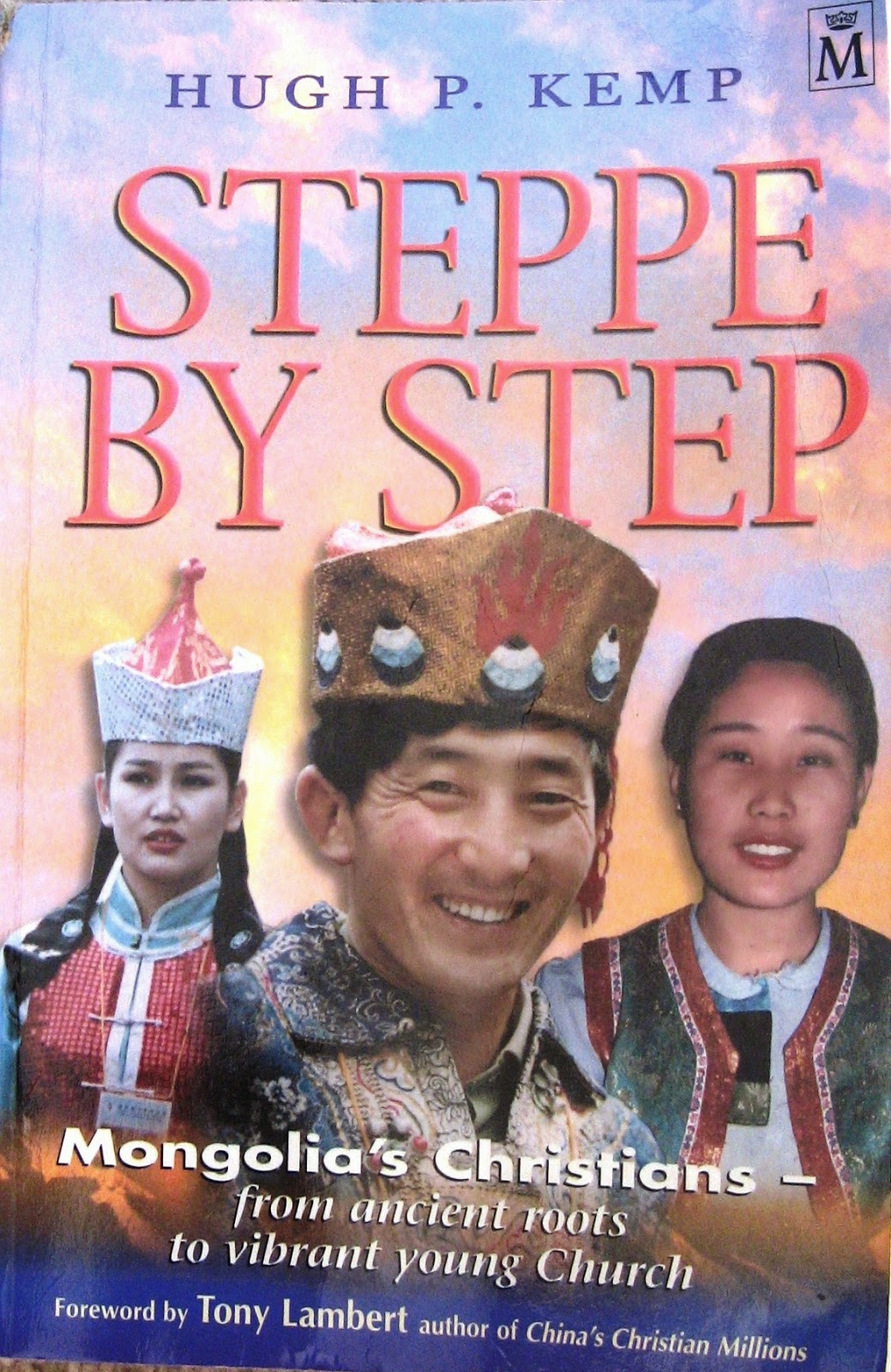
Steppe by Step by Hugh Kemp


Steppe By Step
Hugh Kemp (OMF Publishing)
Monarch Books 2000
ISBN 1 85424 484 1
543 pp


For those who think missionary work in Mongolia has happened only recently, this book by Hugh Kemp will delight and enlighten.

Kemp has a strong background in missions, having grown up in India and worked in Mongolia in church planting and Theological Education by Extension. He and his family went to Mongolia in 1992 with Interserve, and have done several repeat visits.

A skilled researcher, Kemp would like us to know the true history of God’s work in Mongolia. He takes us on a sweeping ride through the centuries, through wars and conquests, boundary realignments and major social changes. He highlights the role of many of the Christian wives and concubines of Mongolia’s rulers who exerted subtle influence on the policies of their times. In an easy to read narrative, Kemp tells us of mission work done by the Moravians, London Missionary Society, Catholic Mission, and various evangelism efforts in the twentieth century.

The work of western missionaries in more recent years has often been hard going. Seldom did they have good news stories of conversions to send back home, and at times they feared their intercessors would weary of praying. But step by step and with persistence and prayer, the forces of darkness are being replaced with the light of the Gospel. Today in the capital city, Ulaanbataar, Christian churches have been planted strategically throughout the city.

The information is easy to follow, being well served by liberal quotes from various sources with end notes and a comprehensive Bibliography. In his forward Tony Lambert writes: ‘Hugh Kemp has unearthed many significant facts which are not easily obtained elsewhere. First-class research is presented in an enjoyable form.’

Hugh Kemp was urged by Mongolian Christians to write their story. Anyone interested in knowing what God is doing in the world today will enjoy this fascinating account of Mongolian Christians from ancient roots to vibrant young church.


Thursday, March 27, 2014

Who's Your Father by Robert Bernecker


Who’s Your Father?
Robert Bernecker
CreateSpace Independent Publishing Platform
North Charleston, South Carolina. 2013
227 pp RRP $2.86 Kindle edition


Is your God really GOD? Or is he a god made in your own image, a tame god who jumps to do your bidding?
These and other questions are posed in Robert Bernecker’s book, Who’s Your Father.
Bernecker freely admits he is a non-theological lay-person dealing with weighty topics. As such, however, he relates well to the common person and every point he makes is backed up by Scripture, with the pages littered with Scripture references, and extensive quotes from eminent Christian scholars.
Much of the teaching in the church today is shown to be false by the clear teaching of Scripture. There are many ways in which we attempt to bring God down to our own size or make him in our own image.
 Bernecker opens his discussion with the illustration of the sparrows that Jesus used (Matthew 10:29). Here he challenges us to a right view of God’s sovereignty and his minute involvement in our lives.
If God had all power but did not love us, or loved us but did not have all power, what confidence could we have in him? ‘Jesus, however, showed us that our God gives to us the perfect combination of unlimited love and unbounded sovereignty,’ he writes. ‘We can, therefore, have a real and living faith.’
 Following chapters discuss the erroneous concept of a ‘Gentleman God’ and the role of faith because with our finite minds we CANNOT understand God’s ways. Is God unfair? Are we puppets or robots? Does God override our free will?
The book would be easier to read if it had shorter chapters and paragraphs and less unnecessary repetition. At times I struggled, but these are deep truths and it takes concentration to grasp the message. Prayer and an open Bible to check out the Scripture passages are vital.
Bernecker’s goal is to draw us closer to our God who is with us not only in our past and future, but also in each moment of the present.
The Lord reigns, let the earth rejoice. (Psalm 97:1) Whatever the Lord pleases, he does, in heaven and on earth, in the seas and all deeps. (Psalm 135:6)
This is our God, the God who wants an intimate relationship with us and in whom we can have total confidence.